After the Diagnosis: What the Evidence Says We Can Still Do
Alzheimer's disease and related dementias are progressive, and there is no intervention that fully stops them. The rate at which decline happens, and the experience of life along the way, can be influenced by evidence-based interventions that can slow the progression of the disease.
By Julia Singler, EdD | Founder, EngAGE Beverly | April 2026
Most of what families read in the early days after a dementia diagnosis falls into one of two unsatisfying categories. There are the strategies around prevention, and what your loved one might have done differently across a lifetime, which is largely beside the point once a diagnosis is in hand. There is also the language of inevitability, which suggests that nothing really helps, that decline is what it is, that the best we can do is manage the descent.
The evidence tells a more useful story than either of those. AD is progressive, and we do not, today, have any intervention that fully halts it. That is true and worth saying plainly, because false hope is its own kind of harm. What is also true is that the rate at which decline happens, the quality of life experienced along the way, and the burden carried by caregivers are not fixed. The research on what genuinely helps, once dementia is already underway, is substantial and worth taking seriously.
The 2024 update of the Lancet Commission on dementia, currently the most authoritative synthesis of the global evidence base, distinguishes between three phases of dementia work: prevention across the life course, intervention after diagnosis, and care across disease progression (Livingston et al., 2024). The literature on each phase is different. What protects cognition for someone in their fifties is not the same body of evidence as what helps someone living with mild-to-moderate Alzheimer's today. This post is about that second and third body of evidence.
Cognitive Stimulation Therapy
The most thoroughly studied non-pharmacological intervention for mild-to-moderate dementia is Cognitive Stimulation Therapy, or CST. Developed by Dr. Aimee Spector and colleagues at University College London in the early 2000s, CST is a structured group activity program built around themed discussions, word games, current-events conversations, and gentle problem-solving tasks designed for adults whose cognitive abilities are changing.
The 2023 Cochrane review, drawing on 37 randomized controlled trials (RCTs) with 2,766 participants across 17 countries, found moderate-quality evidence that CST produces a small but clinically meaningful improvement in cognition, equivalent to roughly a 2-point benefit on the Mini-Mental State Examination compared to usual care, alongside benefits in self-reported quality of life, communication, and mood (Woods et al., 2023). A 2024 meta-analysis using the original 14-session CST protocol confirmed these effects (Lobbia et al., 2024).
These effects are small to moderate, not enormous; they are also real, replicated across continents and care settings, and produce no reported adverse effects. The first author of the original CST trial put it bluntly: "the results compare favorably with trials of drugs for dementia" (Spector et al., 2003).
In our home: The Tuesday morning rhythm at EngAGE Beverly is built directly on this evidence. Reading Roundtable, developed by Dr. Cameron Camp at the Center for Applied Research in Dementia, applies CST principles to group reading: short, accessible passages read aloud and discussed together. Around it we layer choice-based activities (sorting, matching, current-events reading, lunch preparation work) drawn from the same evidence base.
Physical Activity
The second well-evidenced intervention for active dementia is regular physical activity. A meta-analysis of 18 randomized controlled trials with 802 dementia patients found a positive overall effect on cognition, driven specifically by aerobic exercise and independent of dementia type (Groot et al., 2016). A 2023 meta-analysis of 18 RCTs in older adults with dementia found similar improvements in executive function (Zeng et al., 2023).
Two findings are particularly important. First, the benefits hold across dementia types: Alzheimer's, vascular, mixed presentations. Second, more is not necessarily better. Lower-frequency, sustainable exercise routines produce comparable benefits to high-intensity ones, meaning gentle, consistent movement matters more than ambitious training programs that families cannot maintain.
In our home: Tuesday and Thursday mornings include a daily movement block. Tuesdays rotate through chair yoga, tai chi, seated dance, and partner stretching. Thursdays add gross motor games (balloon volleyball, parachute play, cornhole, ring toss) and a walk to Hurley Park, less than a block away, for nature gathering. Nothing strenuous. Everything sustainable.
Music and Reminiscence
Beyond cognition itself, two interventions stand out for their effects on the lived experience of dementia. The Cochrane review of music-based therapeutic interventions found moderate-quality evidence that music therapy reduces depressive symptoms and overall behavioral problems (van der Steen et al., 2018), and a 2023 meta-analysis of 22 RCTs across 1,780 patients confirmed broader benefits across cognition, quality of life, and neuropsychiatric symptoms (Lin et al., 2023). The Cochrane review of reminiscence therapy found small but real benefits in quality of life, cognition, communication, and mood (Woods et al., 2018).
Why these approaches work is partly understood. Musical memory and emotional memory are among the last cognitive functions to deteriorate. Songs from a person's youth can reach them when ordinary conversation cannot. Both interventions work because they meet people where their preserved abilities still are, rather than asking them to function at a level they no longer can.
In our home: Music threads through every morning at EngAGE Beverly: era-appropriate music during arrivals, sing-alongs as part of Thursday's rhythm, music accompanying movement. Familiar songs that members likely know by heart ("You Are My Sunshine," "Take Me Out to the Ballgame," hymns, holiday songs) appear regularly. The "Weekly News" the Singler daughters produce as part of their homeschool curriculum includes a "This Week in History" section designed to evoke shared memories of the years that shaped our friends.
Caregiver Support
No discussion of dementia care is complete without the people doing the day-to-day caring. The 2020 update of Pinquart and Sorensen's comprehensive meta-analysis synthesized 282 controlled studies and found significant effects on caregiver burden, depression, anxiety, and well-being. Multicomponent interventions, combining education, skills training, peer support, and practical assistance, were the most consistently effective (Cheng et al., 2020). More recent meta-analyses confirm these patterns (Rodriguez-Alcazar et al., 2024; Lian et al., 2025).
The evidence consistently points toward the same conclusion: caregivers benefit most when they receive a combination of practical skills training, emotional support from peers who understand, and respite. No single component does the whole job.
In our home: EngAGE Beverly's model treats family members as care partners, not as visitors. The community lunch each week, when caregivers join their loved one for the final half-hour over coffee and dessert, is itself a form of structured peer support and respite. Caregivers see other families navigating similar journeys, and have a few hours each week when their loved one is genuinely cared for in their absence.
Integrated Care
The interventions above are typically studied one at a time. The more interesting question is what happens when they are combined into a single coordinated approach. A recent study by Fang and colleagues (2025) compared 126 AD patients receiving an integrated care approach with 122 patients receiving usual care across nine healthcare facilities, over 24 months. The integrated care group experienced cognitive decline at roughly half the rate of usual care, alongside improvements in quality of life, substantial reductions in behavioral symptoms, and 42% fewer emergency department visits.
These are large effects. The study has limitations: it was quasi-experimental, conducted at facilities in eastern China, and has not yet been independently replicated, so some interpretive caution is warranted. The direction of the findings, however, is consistent with what the Cochrane reviews, the Lancet Commission, and dozens of meta-analyses have found across individual interventions.
There is no intervention today that stops dementia, but the rate of decline, the quality of life along the way, and the burden carried by caregivers can be positively influenced by evidence-based interventions.
What This Means for Families
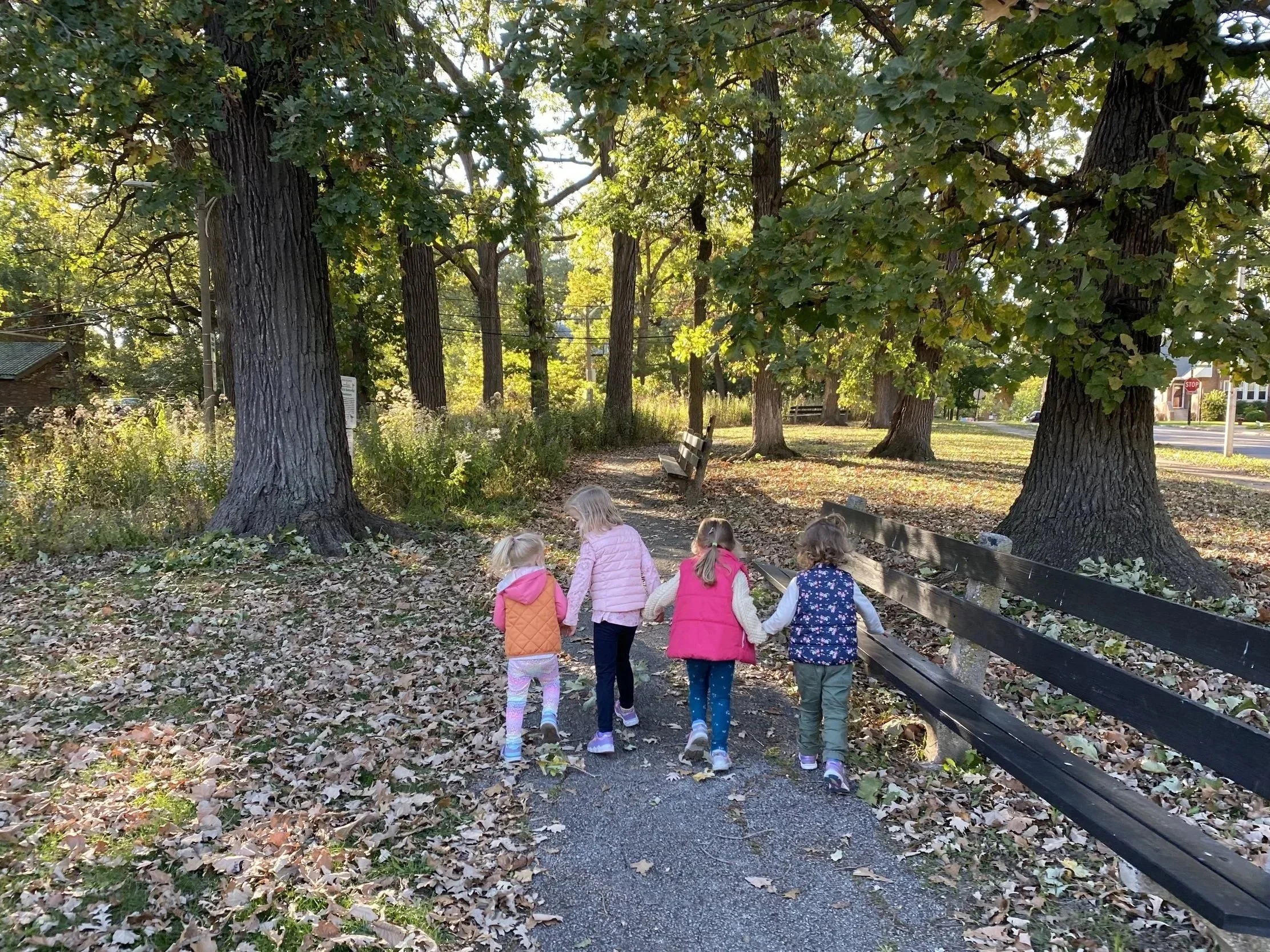
Pops's granddaughters walking in Hurley Park, less than a block from EngAGE Beverly.
The diagnosis is not a verdict on what comes next. It is a beginning, and what follows depends in significant part on what kind of life surrounds the person you love. The research consistently points in the same direction: cognitive engagement, regular gentle movement, music and reminiscence, person-centered relationships in a calm and predictable environment, and meaningful caregiver support all contribute to better outcomes, both for the person with dementia and for the family members caring for them, because those two outcomes are bidirectionally linked. None of these is a cure, but a holistic integration of these evidence-based interventions has been shown to support quality of life for a person with dementia and their caregiver.
At EngAGE Beverly, we are committed to doing what the evidence currently supports, doing it with the warmth and consistency the research suggests matters, and continuing to learn. It is a commitment to a practice rooted in the best evidence we have today, refined as the evidence grows, and offered in the spirit of building something that promotes dignity for older adults and supports the wellbeing of the families who love and care for them.
Julia Otter Singler, EdD
Founder, EngAGE Beverly NFP | Beverly, Chicago's South Side
Reach me directly: julie@engagebeverly.com
A note on how this was written: This post was drafted with assistance from AI as a research and writing aid, and reviewed and edited by Julie Singler before publication. The research synthesis, citations, and conclusions reflect Julie's reading of the underlying literature.
References
1. Cheng, S. T., Li, K. K., Losada, A., Zhang, F., Au, A., Thompson, L. W., et al. (2020). The effectiveness of nonpharmacological interventions for informal dementia caregivers: An updated systematic review and meta-analysis. Psychology and Aging, 35(1), 55-77.
2. Fang, H., Cui, F., Zhao, Y., Qian, Q., Yong, A., Lan, P., & Huang, C. (2025). Transforming Alzheimer's disease nursing: integrating holistic care, innovative interventions, and evidence-based practices for enhanced patient outcomes. Frontiers in Public Health, 13, 1624310.
3. Groot, C., Hooghiemstra, A. M., Raijmakers, P. G. H. M., van Berckel, B. N. M., Scheltens, P., Scherder, E. J. A., van der Flier, W. M., & Ossenkoppele, R. (2016). The effect of physical activity on cognitive function in patients with dementia: A meta-analysis of randomised control trials. Ageing Research Reviews, 25, 13-23.
4. Lian, L., Li, E., Yu, Q., Huang, L., Jin, Y., Bian, H., Yu, S., & Yu, M. (2025). Meta-Analysis Reveals Consistently Positive Effects of Dementia Caregiver Interventions on Psychological Distress. Dementia and Geriatric Cognitive Disorders.
5. Lin, T.-H., Liao, Y.-C., Tam, K.-W., Chan, L., & Hsu, T.-H. (2023). Effects of music therapy on cognition, quality of life, and neuropsychiatric symptoms of patients with dementia: A systematic review and meta-analysis of randomized controlled trials. Psychiatry Research, 329, 115498.
6. Livingston, G., Huntley, J., Liu, K. Y., Costafreda, S. G., Selbaek, G., Alladi, S., et al. (2024). Dementia prevention, intervention, and care: 2024 report of the Lancet standing Commission. The Lancet, 404(10452), 572-628.
7. Lobbia, A., Carbone, E., Faronato, S., Pennati, F., Borella, E., & Lobbia, T. (2024). Effectiveness of Cognitive Stimulation Therapy (CST) for mild to moderate dementia: A systematic literature review and meta-analysis of randomised control trials using the original CST protocol. Ageing Research Reviews, 97, 102301.
8. Rodriguez-Alcazar, F. J., Juarez-Vela, R., Sanchez-Gonzalez, J. L., & Martin-Vallejo, J. (2024). Interventions Effective in Decreasing Burden in Caregivers of Persons with Dementia: A Meta-Analysis. Nursing Reports, 14(2), 920-933.
9. Spector, A., Thorgrimsen, L., Woods, B., Royan, L., Davies, S., Butterworth, M., & Orrell, M. (2003). Efficacy of an evidence-based cognitive stimulation therapy programme for people with dementia: Randomised controlled trial. British Journal of Psychiatry, 183(3), 248-254.
10. van der Steen, J. T., Smaling, H. J. A., van der Wouden, J. C., Bruinsma, M. S., Scholten, R. J. P. M., & Vink, A. C. (2018). Music-based therapeutic interventions for people with dementia. Cochrane Database of Systematic Reviews, 7(7), CD003477.
11. Woods, B., O'Philbin, L., Farrell, E. M., Spector, A. E., & Orrell, M. (2018). Reminiscence therapy for dementia. Cochrane Database of Systematic Reviews, 3(3), CD001120.
12. Woods, B., Rai, H. K., Elliott, E., Aguirre, E., Orrell, M., & Spector, A. (2023). Cognitive stimulation to improve cognitive functioning in people with dementia. Cochrane Database of Systematic Reviews, 1(1), CD005562.
13. Zeng, Y., Wang, J., Cai, X., Zhang, X., Zhang, J., Peng, M., Xiao, D., Ouyang, H., & Yan, F. (2023). Effects of physical activity interventions on executive function in older adults with dementia: A meta-analysis of randomized controlled trials. Geriatric Nursing, 51, 369-377.